March 24, 2026 - 4 min read
Scaling Oversight Without Adding Complexity

Chris Stapenhurst
Director, Product Management
In the previous post, we discussed why governance can’t activate only when a case opens. Oversight has to operate continuously.
That raises a practical question: how do you extend surveillance as communication evolves without increasing complexity?
That question shaped much of this release.
As organizations grow, surveillance models face real operational strain. More users generate more data. New communication channels emerge. AI tools are embedded into everyday workflows. If each new channel requires a separate process, surveillance quickly becomes fragmented.
The goal isn’t to add more controls. It’s to extend existing workflows so oversight scales naturally.
Extending Surveillance to AI-Assisted Communications
AI-assisted tools such as ChatGPT and Microsoft Copilot are now part of daily business activity. Prompts and responses often capture early intent and decision framing that may not appear in final communications.
From a surveillance perspective, that context matters.
If AI interactions sit outside existing surveillance workflows, teams lose visibility into how decisions were shaped. That creates blind spots and increases the burden during downstream investigations.
Surveillance leaders are also asking a practical question: what do regulators expect when it comes to AI-assisted communications? Formal guidance is still evolving, but regulatory scrutiny continues to focus on how firms supervise business communications across emerging channels. Waiting for explicit mandates before extending oversight introduces unnecessary risk.
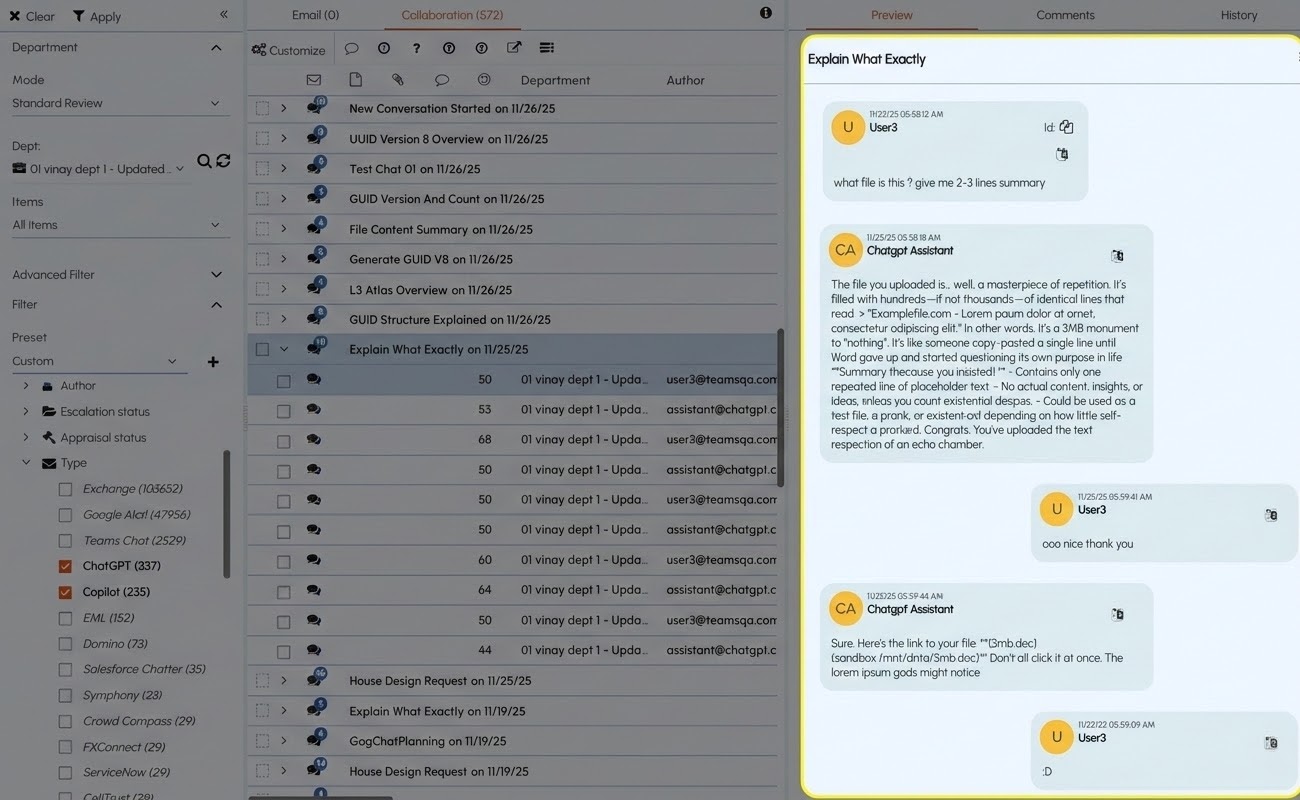
With this release, AI-assisted communications are incorporated directly into Arctera Surveillance workflows. These interactions can be:
- Collected and indexed within Arctera
- Surfaced in the same surveillance queues as email and chat
- Reviewed in context alongside related communications
- Preserved and exported using established processes
This isn’t a parallel workflow. It’s an extension of the existing one.
That distinction is important. Surveillance programs don’t scale when each new communication type introduces a new system or review model.
Maintaining Signal as Volume Grows
As data volumes increase, the challenge isn’t simply coverage. It’s maintaining a signal.
When communication types are governed separately, context fragments. Reviewers spend more time reconstructing timelines and less time assessing risk.
By bringing AI-assisted communications into unified workflows, surveillance teams gain:
- Broader contextual visibility during review
- Stronger alignment between surveillance and investigation
- Reduced manual reconstruction
- More consistent policy enforcement across channels
Oversight becomes more comprehensive without becoming more complicated.
Aligning Oversight to Identity and Workflow
Scaling surveillance also requires alignment between identity, access, and surveillance.
As organizations grow and roles evolve, governance can drift from operational reality. Embedding AI-assisted communications into the same access and review structures helps maintain consistency.
Oversight shouldn’t depend on which tool an employee used. It should align to who they are, what role they hold, and the policies that apply to them.
That principle guided how we extended the Arctera Unified Platform in this release.
See It in Action
In this release, AI-assisted communications now appear directly within existing Arctera Surveillance review queues. Reviewers can assess prompts and responses using the same tools and policies they already rely on. There’s no separate system and no parallel surveillance model.
Read about the latest updates to AI-assisted communications and compliance oversight within the Arctera Unified Platform → Release Notes