
AI Governance Solutions for Innovation with Confidence
Why AI Governance Matters
AI adoption can create new information governance challenges. Without clear visibility and control over business information, organizations may struggle to manage sensitive data exposure, retention obligations, compliance requirements, and AI-related risk.

Sensitive Information can be Exposed
AI-enabled tools may access, process, or surface sensitive, regulated, or business-critical information without appropriate controls.

Retention Obligations still apply
AI-generated and AI-assisted content may still be subject to records retention, legal, regulatory, and business requirements.

Unmanaged Data increases AI Risk
Redundant, outdated, and unmanaged information expands the data footprint organizations must govern and protect.
Responsible AI Adoption Needs a Governed Foundation
Without clear information governance, organizations can lose visibility into sensitive, regulated, and business-critical content as AI use expands, creating unnecessary risk before issues become apparent.

Confidence Is Not Defensibility
Learn why responsible AI governance must move beyond policies and controls to provide the evidence, context, and accountability needed to defend AI-assisted decisions.
See why a governed information foundation is essential.
Build Responsible AI on Governed Enterprise Information
AI governance begins with information governance. Arctera helps organizations establish the visibility, control, and defensibility needed to support responsible AI adoption across the information lifecycle.
Gain greater visibility
into business-critical and sensitive information
Preserve information
for legal, regulatory, and investigative needs
Apply consistent retention
and disposition policies
Reduce unnecessary data exposure
across the information lifecycle
Improve the defensibility
of information management decisions
Support AI
initiatives with trusted, governed information
Key Capabilities of Arctera’s AI Governance Solution
Arctera helps organizations understand, control, retain, and preserve the information that supports AI-enabled business processes.

Identify and Classify Sensitive Information
With stronger visibility into information, organizations can better determine what content should be protected, retained, restricted, or reviewed before it is used in AI-enabled processes.

Apply Retention Policies Consistently
Apply consistent retention policies across information sources, helping ensure that important content is preserved for the appropriate period and disposed of when it is no longer required.

Reduce Unnecessary Data exposure
Improve information hygiene, organizations can create a more controlled environment for responsible AI adoption.

Preserve Information for Legal and Compliance needs
Supporting more efficient response processes and helping organizations demonstrate control over their information.

Maintain Visibility Across Enterprise Data and Information
More informed decisions around AI risk management, data governance, compliance, and information lifecycle management.

Enable Responsible AI adoption
Allow teams to pursue AI innovation while maintaining control, accountability, and compliance readiness.

Business Benefits of Arctera AI Governance Solutions
Arctera helps organizations:
checkin-circle: Reduce AI-related information risk by improving visibility and control over sensitive and high-risk content
checkin-circle: Strengthen compliance readiness with consistent retention, preservation, and information lifecycle practices
checkin-circle: Improve data governance by identifying and managing information that requires greater oversight
checkin-circle: Enable responsible AI adoption with a more trusted foundation for AI-enabled business processes
checkin-circle: Increase defensibility by supporting consistent, documented information management decisions
checkin-circle: Help teams innovate with confidence by reducing uncertainty around information use, retention, and exposure
Why Choose Arctera for AI Governance Solutions?

Arctera brings deep experience:
Helping organizations manage complex enterprise information across compliance, and information governance initiatives.
Rather than treating AI governance as a disconnected technology challenge, Arctera helps organizations address the underlying information lifecycle issues that shape AI risk and readiness. This includes understanding what information exists, applying policies consistently, preserving what matters, and reducing unnecessary exposure over time. With Arctera, organizations can build a practical, defensible approach to AI governance that aligns innovation with information control.
Support AI Governance Across the Enterprise
Effective AI governance requires collaboration across legal, compliance, information governance, security, technology and business teams.

Compliance and Risk Teams
Support AI compliance and risk management efforts by identifying sensitive information, applying consistent policies, and improving visibility into the information that may be used in AI-enabled workflows.

Legal and eDiscovery Teams
Preserve, discover, and manage relevant business information for litigation, investigations, audits, and regulatory matters, regardless of whether that information was created or influenced by AI.
Records and Information Management Teams
Extend established records management and retention practices to address new content types, business processes, and information risks introduced by AI adoption.
IT and Security Leaders
Reduce unnecessary data exposure, improve control over enterprise information, and support broader data governance initiatives that help the organization use AI more responsibly.
Business and Transformation Leaders
Create a stronger foundation for AI innovation by ensuring the organization’s information is governed, trusted, and managed in alignment with business, legal, and compliance requirements.
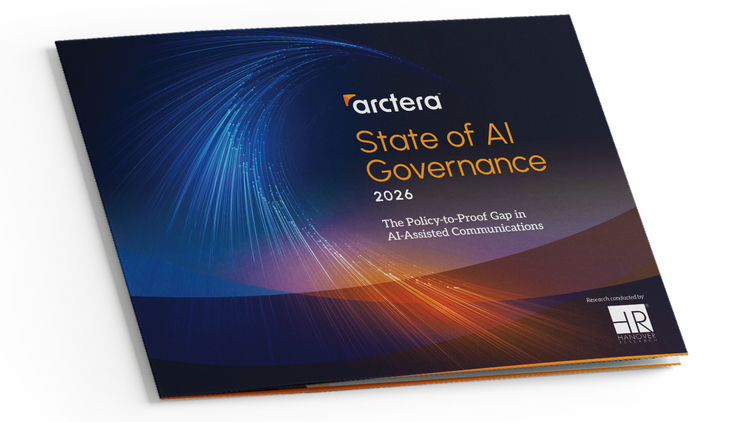
Explore the State of AI Communications Governance 2026
New research reveals how organizations are adopting AI, where governance controls remain incomplete, and why trusted information and defensible evidence are becoming increasingly important.
Explore the findings to understand the gap between AI adoption, governance confidence, and operational readiness.
Frequently Asked Questions
AI governance solutions help organizations establish the policies, responsibilities, and controls needed to manage how artificial intelligence is adopted and used.
They can address areas such as accountability, risk management, data protection, compliance, and information governance.
Arctera strengthens the information-management layer of AI governance by helping organizations identify, classify, retain, preserve, and defensibly manage enterprise information.
Information governance provides the foundation for AI governance.
Organizations need to understand what information they hold, where it resides, how long it should be retained, and whether it contains sensitive or regulated content.
Strong information governance helps teams make more informed decisions about what information can be used, protected, preserved, restricted or removed from AI-enabled environments.
Strong data and information governance gives organizations greater confidence in the content AI systems can access and use.
It helps reduce sensitive-data exposure, improve information quality, apply lifecycle policies consistently, and maintain evidence for legal, compliance, and investigative requirements.
Responsible AI Starts with Trusted Information
AI can help organizations move faster. Trusted, governed information helps them move forward with confidence.
Build the information governance foundation needed to support responsible AI adoption, reduce risk, and maintain control over the information that matters most.