
The State of AI Communications Governance 2026
AI Governance Has Moved into the Communications Workflow
AI is an active governance issue: 71% of surveyed organizations use AI within regulated communications or decision-making workflows. This means AI content has already entered areas Compliance governs, including communications, records, reviews, investigations, and decisions.
This creates a practical challenge for Compliance: ensuring they possess the records, controls, and clear ownership needed when AI communications are questioned. Arctera's research identifies three pressure points: rising risk, accountability falling to Compliance, and a lack of records to demonstrate what happened.
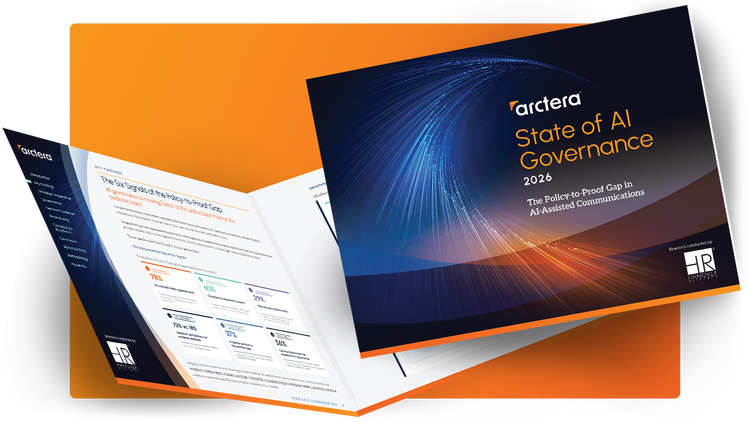
What You Will Gain from the Report
checkin-circle: Map where AI-assisted tools enter regulated communications workflows
checkin-circle: Identify where AI policies may not produce defensible records
checkin-circle: Pressure-test whether your organization can reconstruct AI inputs, outputs, edits, reviews, and approvals
checkin-circle: Reduce manual effort when evidence is spread across disconnected systems
3 Critical AI Governance Signals from the Benchmark
AI risk is rising, Compliance is increasingly accountable, but many teams lack the records needed to reconstruct AI-assisted communications when questions arise.
78%-Expect AI communications risk to increase
60%-Assign primary accountability to Compliance
Only 19%-Have the records needed to show what happened
Where AI Communications Become Harder to Govern
The reality of AI work is rarely a linear record. When a regulator asks to reconstruct a decision, they aren't looking for just the final message—they need the context: the prompt, the draft, the human intervention, and the review. Currently, that story is often scattered across different tools and team silos. For Compliance, this creates a "black box" where you are forced to piece together fragments rather than present a complete, defensible history.
VISUAL SUMMARY
Where the Record Starts to Fall Behind
AI communications governance meter showing the drop-off in AI-recordkeeping: 65% of AI prompts are monitored, but only 18% of organizations are investigation-ready.

KEY FINDINGS
The Blind Spots in Your AI Governance Strategy
Our research identifies three critical gaps where AI-assisted communications create unmonitored risk, break audit trails, and fragment your evidence.

Invisible Usage Creates Unmonitored Risk
solid-dot: Pervasive adoption: AI use now extends well beyond isolated experimentation.
solid-dot: Hidden workflows: Content appears in both approved tools and unmonitored channels.
solid-dot: The visibility gap: You cannot review, retain, or defend what you cannot see.

Policies Are Not Proof
solid-dot: The readiness gap: Having a policy is not a record; it is not audit-ready.
solid-dot: Indefensible reviews: Human reviews are indefensible without a complete history.
solid-dot: Misaligned controls: Legacy records fail to track how AI work actually flows.

Fragmented Data Stalls Investigations
solid-dot:Scattered content: AI data fragments across separate tools, archives, and case files.
solid-dot: Manual reconciliation: Disconnected systems create bottlenecks before analysis can even start.
solid-dot: Delayed response: Readiness demands a speed you cannot achieve with scattered records.
Can You Reconstruct What Happened?
When an AI-assisted outcome is questioned, policies are not your defense—evidence is. Regulatory scrutiny peaks when Compliance must explain the inputs, edits, and human approvals behind a record. If this data is trapped in disconnected systems, teams lose critical time reconstructing the timeline. To maintain investigation readiness, leading organizations are focusing on four operational priorities.

Map the AI Footprint
Identify where AI is used to draft, summarize, review, or support communications and decisions.

Keep Context with Higher-Risk Records
Retain the inputs, outputs, edits, approvals, review history, and retention details needed to explain the work.

Connect Systems Before Teams Have to Rebuild the Story
Align archives, review, legal hold, case management, and production workflows.

Define Ownership Before Questions Arise
Clarify who owns review, escalation, retention, investigation response, and production.
Benchmark Your AI Communications Governance Readiness
Dive deeper into 35+ pages of research from interviews with 500 compliance experts globally. Download the full report to see where organizations are prepared, where records fall behind, and how governance teams can close the gap.


Ready to Get Ahead of AI Communications Risk?
Continue Your Research

What is AI Governance?

Bridge the Gap Between Enterprise Memory and AI