
The State of AI Communications Governance 2026
AI Governance Has Moved into the Communications Workflow
AI is no longer a future governance issue. In Arctera’s research, 71% of surveyed organizations use AI moderately, extensively, or as core to workflows involving regulated communications or decision-making. That means AI-assisted content is already entering the places Compliance teams are expected to govern: communications, records, reviews, investigations, and decisions.
The harder question is whether Compliance teams have the records, controls, and ownership clarity needed when AI-assisted communications are questioned. The research points to three pressure points: risk is expected to rise, accountability often lands with Compliance, and many organizations still lack the records needed to show what happened.
Three Pressure Points for Compliance Teams
AI is already part of regulated work. Now compliance teams need to prepare for what comes next: more risk, more accountability, and more pressure to show the record behind AI-assisted communications.
78%-Expect AI communications risk to increase
60%-Assign primary accountability to compliance
Only 19%-Have the records to show what happened
Where AI Communications Become Harder to Govern
AI-assisted content can move quickly across tools, channels, records, and teams. A prompt may become a draft, a draft may become a message or case note, and the final record may live somewhere else. For Compliance, the challenge is whether the context stays with it: where it came from, who reviewed it, whether it was retained, and how it can be explained when questions arise.
VISUAL SUMMARY
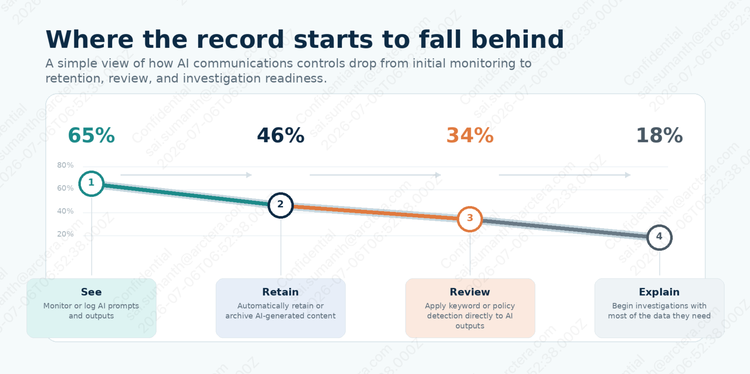
Where the Record Starts to Fall Behind
AI communications governance meter showing how records, retention, review, and investigation readiness can become harder to maintain across regulated communications.
RESEARCH REPORT - KEY FINDINGS
The Blind Spots in Your AI Governance Strategy
Our latest research reveals the three critical gaps where AI-assisted communications are creating unmonitored risk, incomplete audit trails, and fragmented records.

Lack of Visibility into AI Usage
AI is already deeply embedded in regulated workflows, but compliance teams lack clear visibility. Without tracking where AI-assisted content enters the business, teams cannot effectively monitor how it impacts final messages, records, or decisions.
solid-dot: Pervasive adoption: AI use is no longer limited to isolated experimentation.
solid-dot: Hidden workflows: AI-assisted content frequently appears in both approved tools and unmonitored channels.
solid-dot: The visibility gap: Teams cannot review, retain, or defend data they do not know exists.

Policies Fail to Create Defensible Audit Trails
Corporate AI policies outline expected behavior, but they do not automatically generate the practical records needed during an inquiry. When questions arise, compliance teams lack the end-to-end history of inputs, outputs, and edits to prove what actually happened.
solid-dot: The readiness gap: Having an AI policy is not the same as having audit-ready records.
solid-dot: Indefensible reviews: Human oversight is difficult to defend when the underlying review history is incomplete.
solid-dot: Misaligned controls: Existing records and compliance controls fail to track how AI work actually flows.

Fragmented Data Stalls Compliance Investigations
When AI-assisted communications are called into question, teams waste critical time piecing together fragmented data. Because the final message alone doesn't tell the whole story, compliance must manually extract records scattered across disconnected departmental systems.
solid-dot:Scattered content: AI data fragments rapidly across different tools, archives, and separate case files.
solid-dot: Manual reconciliation: Disconnected systems force teams to gather and clean data before an analysis can even begin.
solid-dot: Delayed response: Investigation readiness depends on the ability to quickly locate, connect, and explain the full record.
Can You Reconstruct What Happened?
When an AI-assisted communication or decision is questioned, policies alone won't protect your organization—proof will. Regulatory pressure peaks the moment Compliance is asked to explain the exact inputs, edits, and human approvals behind a specific record. If this data is scattered across disconnected systems, teams lose critical time just trying to piece the timeline together. To maintain investigation readiness, leading organizations are focusing on four operational priorities.

Map the AI Footprint
Identify where AI is used to draft, summarize, review, or support communications and decisions.

Keep Context with Higher-Risk Records
Retain the inputs, outputs, edits, approvals, review history, and retention details needed to explain the work.

Connect Systems Before Teams Have to Rebuild the Story
Clarify who owns review, escalation, retention, investigation response, and production.

Define Ownership Before Questions Arise
Clarify who owns review, escalation, retention, investigation response, and production.
Access the Full Compliance Report
Dive deeper into 35+ pages of research from interviews with 100 compliance experts globally. See where AI-assisted communications can create gaps in visibility, records, review, and investigations — and how Compliance teams can prepare to show what happened.

What You Will Gain from the Full Report
Download the complete research report to benchmark your AI governance strategy against industry peers and gain actionable insights to protect your organization.
Inside, you will discover how to:
checkin-circle: Map Your AI Exposure: Pinpoint exactly where AI-assisted tools are entering your workflows—from daily messaging to case notes and critical decision-support systems.
checkin-circle: Audit Your Record Readiness: Identify the hidden gaps where your current corporate AI policies fail to generate the defensible audit trails regulators expect.
checkin-circle: Accelerate Investigation Timelines: Learn how to break down data silos across IT, Legal, and Compliance to locate and connect scattered evidence faster.
checkin-circle: Pressure-Test Your Defensibility: Get a practical framework to evaluate your current records, system integrations, and ownership lines before an inquiry arises.

Ready to Get Ahead of AI Communications Risk?
Continue Your Research
Where the record starts to fall behind

Bridge the Gap Between Enterprise Memory and AI