
Shilo Thomas
Product and Solutions Marketing, Data Compliance
Compliance Owns AI Governance—But Not All the Evidence
In regulated enterprises, Compliance isn’t missing from the AI conversation. Most teams already have a seat on the AI steering committee, reviewing vendor terms and drafting acceptable-use guidelines.
The real tension surfaces months later, when the first AI-assisted communication is challenged:
Approving a policy is very different from having custody of the evidence.
When an inquiry hits, the question isn’t “Did we have a policy?” It’s “Can you prove exactly what happened?”
For most organizations, answering that question lands squarely on Compliance. Our State of AI Governance 2026 benchmark revealed that 60% of organizations place primary accountability for AI-generated communications directly on Compliance—compared to just 19% with a dedicated AI governance team.
Compliance holds the accountability. But they rarely control the systems where the evidence lives.
The Perception Blind Spot
Accountability also depends on who you ask.
In our benchmark, over 80% of Compliance leaders stated their department carries primary accountability for AI-generated communications. Yet across IT, Legal, and Risk, only about 40% agreed.
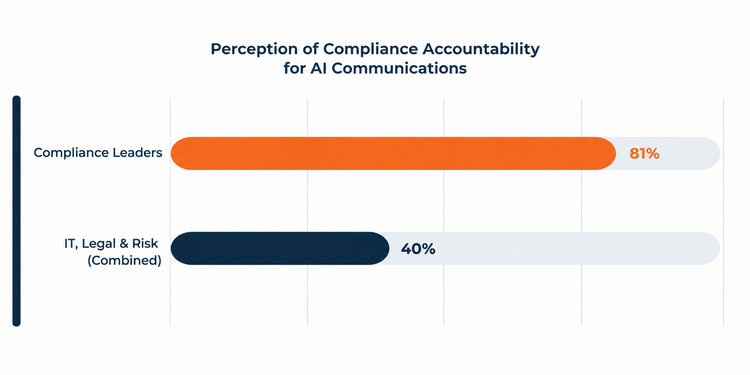
This isn't friction—it's a shared blind spot. Responsibility is assumed in silos, leaving critical evidentiary questions unanswered until scrutiny arrives.
The Scattered AI Data Path
Consider a routine interaction playing out across desks every day:
- The Prompt: An advisor uses an approved AI tool to draft a portfolio update. The prompt and output sit inside that standalone tool.
- The Context: Supporting numbers are pulled from an internal CRM.
- The Review & Approval: A manager redlines the text in email, and gives final sign-off in a quick chat thread.
- The Archive: The final email goes to the client and enters standard message archiving.
The interaction worked seamlessly. But the audit trail is fractured across five disconnected applications:
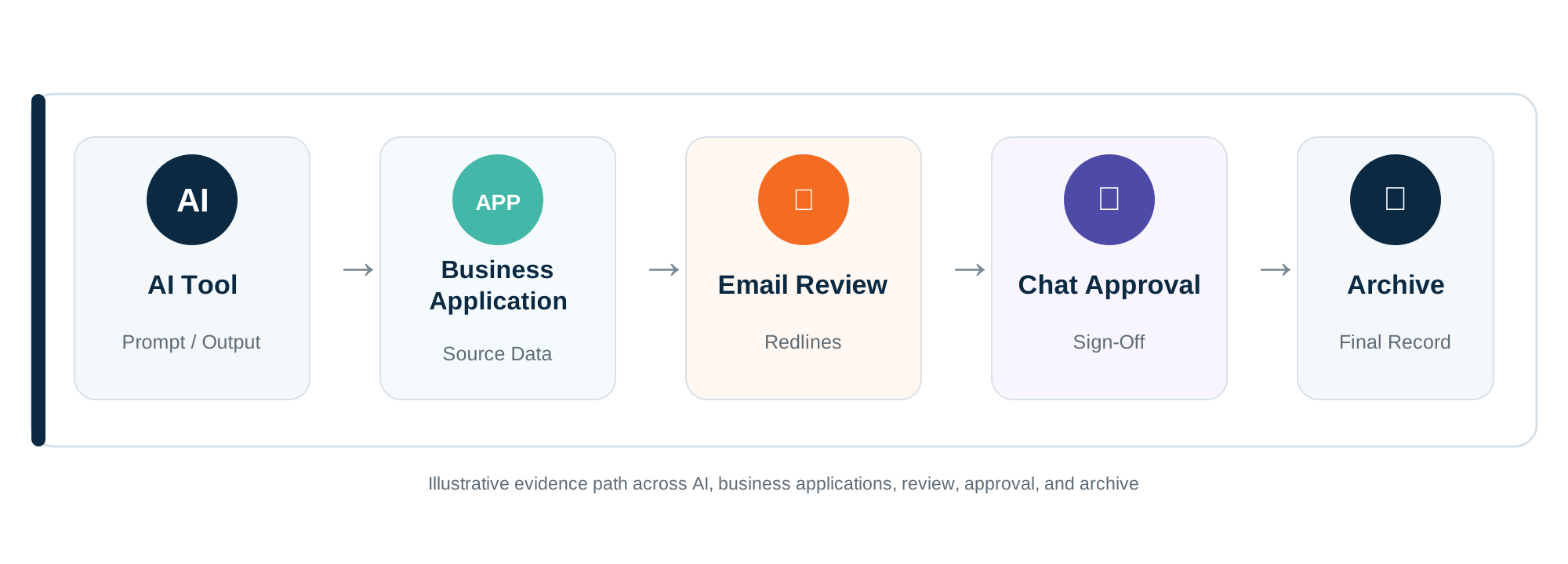
When an auditor asks for the supervisory chain, Compliance must explain the full decision path. Yet no single platform holds the complete story.
COMPLIANCE IN PRACTICE:
- Episode 1: Who Owns AI Compliance Data in Organizations? What does the accountability gap actually look like when Compliance is on the hook to answer for AI-assisted work, but the evidence is scattered across tools owned by IT, Legal, and business teams?
- Join me as I sit down with Phil Yaccino, Account Technical Strategist at Arctera, for a candid discussion on where teams get tripped up, what a defensible AI record must include, and how to connect the dots without ripping and replacing your existing stack.
Watch the Discussion: See What This Means in Practice
Defensibility Without the Scramble
Our benchmark found that organizations with integrated governance structures are nearly twice as likely (61% vs. 31%) to feel extremely prepared to produce a defensible AI audit trail.
Defensibility doesn’t require ripping out existing technology or forming another committee. It requires connecting the AI data path.
Compliance brings regulatory context. IT manages platforms. Legal defines obligations. Rather than forcing teams to rebuild from scratch, organizations need governance architecture that extends the archiving, discovery, and surveillance systems they already rely on—linking prompts, outputs, approvals, and final records into an audit-ready chain.
Explore the complete benchmark findings: Download the State of AI Governance 2026 Benchmark Report