Shilo Thomas
Product and Solutions Marketing, Data Compliance
Why AI Policies Do Not Equal Compliance
Almost every regulated firm has checked the first box on AI governance: writing an acceptable use policy.
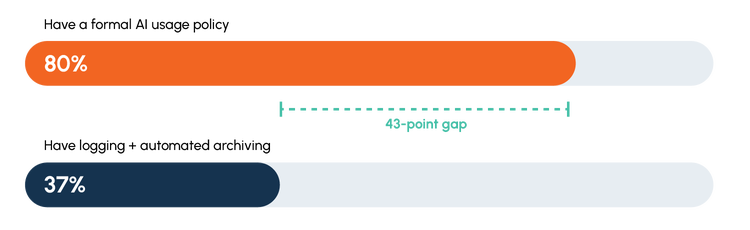
Our State of AI Governance 2026 benchmark found that 80% of organizations using AI in regulated workflows have a formal policy in place. These documents define approved tools, forbid pasting customer PII into public chatbots, and mandate human sign-off on sensitive outputs.
Writing the policy is vital. But relying on it for audit defense is like holding up a paper shield.
A policy describes intent—what employees should do. Defensible compliance requires evidence—what systems and users actually did. When a regulator or client challenges an AI-assisted communication six months later, pointing to a PDF in your internal knowledge base doesn't prove the rule was followed.
AI Compliance Divide
The Gap Behind the Signature
The drop-off between policy coverage and technical enforcement is stark: while 80% of organizations have a formal policy, only 37% have both prompt/output logging and automated archiving in place.
Without those technical guardrails, compliance teams are left with an evidence void:
- Did the employee use the enterprise-approved model or a personal browser extension?
- What source data grounded the model's response?
- What was the initial AI-generated output before human review and editing took place?
- Did the reviewer approve the draft or just acknowledge an email?
- The benchmark shows the tangible impact of closing this void: 98% of policy-led organizations with core logging and automated archiving report feeling extremely prepared to produce a defensible audit trail, compared to just 63% without it.
Connecting Intent to Evidence
Turning written expectations into proof doesn't mean logging every mundane query. It means connecting your policies to the workflows that carry regulatory exposure.
Before scrutiny arrives, ask:
- Entry points: Where is AI entering client-facing communications and high-stakes decisions?
- Translation: Which policy mandates can be automated through capture and surveillance rather than manual employee adherence?
- Reconstruction: If an output is questioned tomorrow, can you produce the prompt, edit history, and approval record without running a digital scavenger hunt?
Arctera helps organizations connect communications, policy rules, and audit trails across archiving, surveillance, and legal hold workflows—so when questions arise, the proof is already waiting.
Has your organization bridged the gap between your AI policy and the underlying technical logs?
Explore the State of AI Governance 2026 Benchmark findings.