Irfan Shuttari
Director of Product Management, Head of AI Strategy
Why AI Needs More Than Access to Enterprise Data
Most conversations about AI focus on what the technology can do. Far fewer focus on where the data – “the moat” – lives.
Yet for organizations operating in regulated environments, that distinction often determines whether an AI workflow can be trusted, governed, and scaled.
AI is already being used across legal, compliance, and investigation workflows. Teams are using it to search, summarize, and analyze information in ways that would have been difficult to achieve only a few years ago.
The question is no longer whether AI can support these workflows. The more important question is how AI interacts with the enterprise data those workflows depend on.
Most approaches today rely on exporting information into external tools or connecting AI through plugins layered on top of existing systems. While that can provide access, it often introduces additional complexity. Data is moved or duplicated. Governance controls must be applied across multiple environments. Results frequently need to be validated back against the system of record before action can be taken.
The ability to generate insight is advancing quickly. Organizations still need confidence in how that insight is produced, validated, and governed.
At some point, organizations are forced to ask a practical question: should AI be brought to the data, or should the data continue to be brought to AI?
That distinction has significant implications for governance.
This is the problem Arctera AI Converge was designed to address.
AI Converge provides a governed framework for connecting AI tools directly to enterprise data, allowing analysis to occur within the same environment where information is already managed, retained, and audited.
At the center of that framework is the Model Context Protocol (MCP), which provides a standardized way for AI tools to interact directly with governed enterprise data. Rather than relying on secondary copies or external repositories, AI can query and operate on information where it already resides.
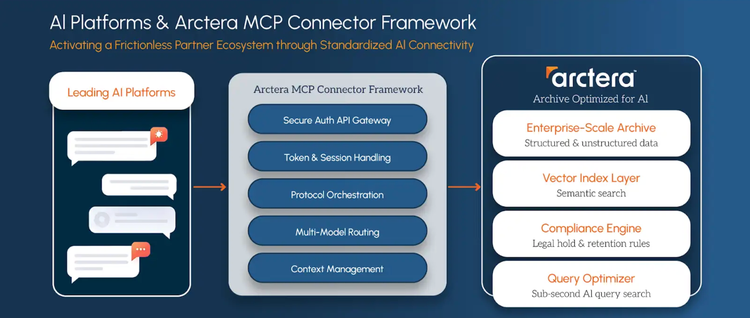
That architectural choice matters.
When AI operates outside the system of record, governance becomes fragmented. Data movement introduces additional risk. Permissions, retention requirements, and audit controls must be maintained across multiple environments. Even when those controls exist, organizations often find themselves validating outputs against the original source before they can rely on them.
The result is additional effort, additional complexity, and often additional uncertainty.
A governed approach produces a different outcome.
By connecting AI directly to enterprise data, organizations can preserve the controls that already exist around that information. Identity, permissions, retention policies, and audit requirements remain tied to the source data rather than being recreated elsewhere.
This allows AI to operate within the same framework that already governs compliance and investigation workflows.
From architecture to implementation
One of the challenges organizations face when evaluating AI is the assumption that new capabilities require new infrastructure. In many cases, that has been true. Data is exported, copied into external environments, and connected through custom integrations before analysis can begin.
AI Converge was designed differently.
Because it operates directly against governed enterprise data, organizations do not need to create secondary repositories or move information into separate AI environments. Existing governance controls remain in place, and AI can operate against the same data already used for compliance, legal, and investigation workflows.
For customers already using Arctera governance solutions, AI Converge can be enabled within the existing environment. There is no separate governance framework to build and no data migration required before teams can begin working with governed AI workflows.
In practice, that means AI can query communications and content in place, analyze information within its full context, and generate outputs grounded in governed records. Access continues to be governed through existing permissions and policies. Auditability remains intact because interactions occur within the same environment where the underlying data is managed.
The value is not simply that AI can access information more efficiently. Context, governance, and analysis remain connected throughout the workflow.
To illustrate how this works in practice, we've included a short walkthrough showing how AI Converge connects directly to governed enterprise data through MCP, allowing teams to begin querying, analyzing, and working with information without moving it outside the system of record.
This becomes increasingly important as organizations expand their use of AI.
The long-term challenge is not adopting a particular model or tool. Those technologies will continue to evolve. The challenge is establishing an approach that allows new AI capabilities to operate within existing governance frameworks without requiring organizations to repeatedly move data, recreate controls, or redesign workflows.
That is ultimately what AI Converge addresses.
Rather than treating governance as a layer applied after analysis, it establishes governance as part of how AI interacts with enterprise information from the start.
The long-term implications of this approach are significant, but the immediate value is practical. Organizations can begin applying AI directly to governed enterprise data today, using the controls, permissions, and governance frameworks they already trust.
As AI becomes a larger part of compliance, legal, and investigation workflows, the ability to connect intelligence directly to governed data will become increasingly important. AI Converge provides a way to do that without moving data, recreating controls, or introducing new governance gaps.
For organizations evaluating how AI can be applied within governed environments, additional detail is available in the release materials, along with a walkthrough of AI Converge and MCP in the accompanying webinar and product demonstration.